

What Is IRR, and Why Does It Matter for Real Estate Investors?
Every real estate deal comes with return numbers. One sponsor may lead with annual cash flow. Another may highlight how much an investor could receive over the entire hold period. These figures answer different questions, and looking at just one can leave out an important part of the story: when you get your money back.
Internal rate of return, or IRR, accounts for that timing. Here is what it measures, why investors use it, and what to check when a sponsor presents a target IRR.
What does IRR actually measure?
IRR is a percentage calculated from an investment’s cash flows: the money you put in, the money distributed to you during the investment, and the money returned at exit. It factors in both how much you receive and when you receive it.
In technical terms, IRR is the rate that makes the present value of those cash flows equal to zero. That is how the U.S. Securities and Exchange Commission describes it. You do not need to work through the formula to use the metric. You do need to know what cash flows, dates, and assumptions went into it.
Why timing matters
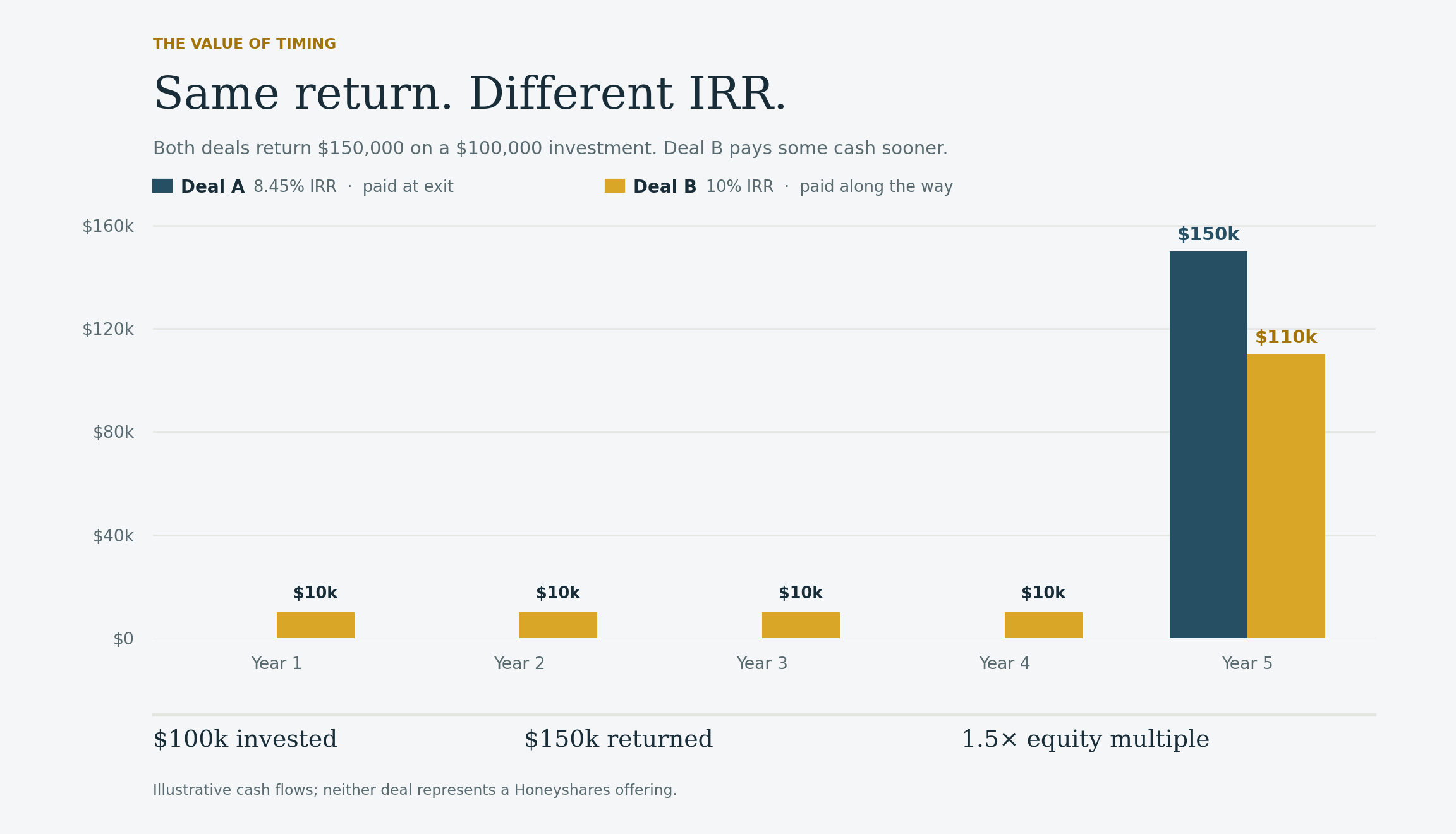
Deal A pays you nothing during the hold period. At the end of year five, you receive $150,000. Its IRR is approximately 8.45%.
Deal B pays you $10,000 at the end of each of the first four years, then $110,000 at the end of year five. Its IRR is 10%.
Both have the same 1.5x equity multiple: $150,000 returned on $100,000 invested. Deal B has the higher IRR because some money comes back sooner.
You may be able to put those earlier payments to work elsewhere, although what you actually earn on them depends on what you do next.
IRR versus the other return numbers
IRR is most useful alongside two other measures:
Annual cash yield, often called cash-on-cash return, compares cash received during a year with the cash you invested. It helps answer, “What income might this investment pay me along the way?” It does not capture the full gain or loss at exit.
Equity multiple compares total dollars returned with dollars invested. A 2x multiple means an investor received twice the amount contributed, including the return of that original capital. It does not say whether that took three years or ten.
IRR incorporates the timing of the projected or actual cash flows. It helps compare investments with different distribution and exit schedules.
An investment may have a high projected IRR but pay little cash until it sells. Another may produce more income during ownership but less profit at exit. Which one fits you depends on your goals for current income, growth, and access to your capital.
What IRR does not tell you
IRR is useful, but it cannot assess a deal by itself.
First, a target IRR is a projection, built on assumptions about revenue, expenses, financing, distributions, and exit value. If the properties earn less than expected or take longer to sell, the actual IRR can be lower. A reported IRR on an investment that has not exited may also rely partly on an estimate of its current value.
Second, IRR says nothing about risk. Two investments can show the same target and have very different exposure to leverage, operating costs, regulation, or a single market.
Third, IRR does not tell you how many dollars you make. A percentage is meaningful, but so are the amount of capital invested and the total dollars projected to come back.
Finally, receiving money early raises another question: what can you earn on those distributions after you receive them? The IRR calculation describes the investment’s cash-flow schedule. It does not guarantee that your overall wealth will compound at that same rate if you hold the distributions in cash or reinvest them elsewhere.
Three questions to ask about a sponsor’s IRR
Is it gross or net? A gross figure does not reflect the same deductions as a net figure. Ask which fees, expenses, and sponsor compensation are reflected in the return shown to investors. “Net” still does not tell you your after-tax result.
Is it a target or a result? A target IRR describes a modeled outcome. A result describes cash flows that have occurred; if an investment has not fully exited, the reported figure may also include an estimated value for what remains. Make sure you know which you are looking at.
Where does the projected return come from? Ask how much is expected from distributions during ownership and how much depends on an eventual sale or refinance. Then look at the assumptions for the exit price and timing. A projected return that relies heavily on a favorable sale years from now deserves close attention.
How we use IRR at Honeyshares
When we underwrite a deal at Honeyshares, we rebuild the numbers from scratch rather than trust a broker's pro forma, because the assumptions beneath an IRR are exactly where deals are won or lost. We would rather underwrite toward a conservative target we can stand behind than a flattering one we cannot. And because we invest our own capital in the funds we run, the return we are modeling is the one we are personally exposed to, not just the one on the page.
IRR is a tool, not a promise. Used well, it helps you compare opportunities honestly. If you want to walk through how we build a projected return, from the cash-flow schedule to the exit assumptions, we are always glad to have that conversation.
